

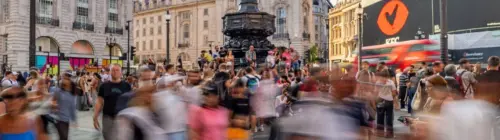
What the new Time Out Market tells us about the West End’s next chapter
Our latest real estate data reveals a market increasingly shaped by experience-led uses.
Announced this summer, the iconic London brand, Time Out is set to open its next famed Market in London’s Piccadilly Circus. The three-floor, 26,400 sq ft destination at 55 Regent Street is due to open in the first half of 2028, bringing restaurants, bars, food businesses, cultural events and entertainment together under one roof.
It is a significant investment in one of our area’s most recognisable locations. But it also points to something bigger: the way people experience the West End is increasingly shaping the way its real estate is being developed.
From space to experience
At HOLBA, we recognise that the West End has always been built around experiences. People come for the theatre, stay for dinner, shop, meet friends, visit an attraction or spend an evening exploring.
What is changing, with the growth of the experience economy, is how deliberately those experiences are being brought together.
Unlocking the Experience Economy. HOLBA report, 2025
- of consumer spending was on experiences
- 34%
- of consumers said they would rather spend money on experiences than material possessions
- 57%
While Time Out Market will add a new layer to Piccadilly Circus, where retail, hospitality, leisure, culture and transport already meet, it won’t be creating an experience destination from scratch. It is investing in one that is already there.
Different districts. Different experiences.
Our latest Economic and Real Estate Summer 2026 Report shows just how significant experience-led uses have become across the Heart of London area and how differently they are distributed across its distinct districts.
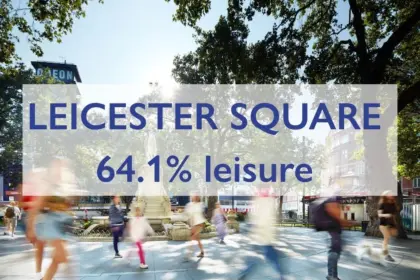
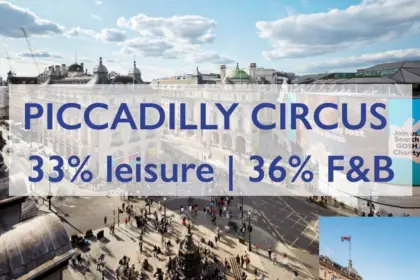
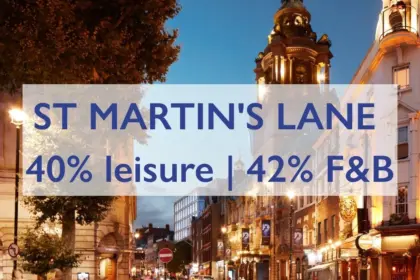
Leicester Square is heavily leisure-led. Piccadilly Circus has a particularly strong mix of leisure and food and beverage. St Martin's Lane combines dining, theatre and hospitality, while Piccadilly and Jermyn Street retain much stronger retail identities.
Different districts. Different reasons to visit. One connected destination.
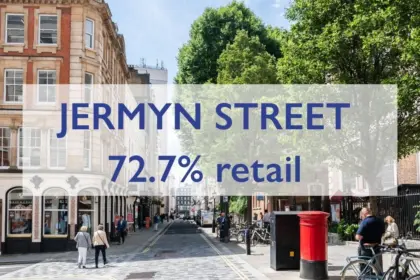
Where we see the opportunity for occupiers, investors or stakeholders in the West End is to understand each destinations identity, its strengths and how it operates. And that’s where our data comes in.
But what is the market saying?
Our economic and real estate analysis for April – June 2026 shows a mixed picture.
Visitor numbers are down compared with 2025, a record year following the pandemic. But the property market is continuing to move, with a reduction in vacant commercial floorspace and more space undergoing alteration.
Q1 2026, HOL AREA
- Vacant commercial floorspace
- -1.6 percentage point
- Floorspace under alteration
- +1.7 percentage points
This is happening against a challenging economic backdrop. Rising operating costs, business rates and energy prices continue to put pressure on hospitality, leisure and cultural businesses.
Consumer confidence also remains below 2019 levels, while cost-of-living pressures continue to affect visitors to the area. Transactions are down quarter-on-quarter, but those who are spending are spending more, with average transaction values increasing.
At the same time, there are signs that consumers remain willing to spend on experiences they value. Spending in Hobbies & Interests increased by 30%, driven by theatre and in-venue spending.
Q1 2026, HOL AREA
- Visits to the HOL area, year-on-year
- -4.8%
- Average transaction value
- +2%
- Hobbies & Interests spending
- +30%
Making the West End work as a whole
So our opportunity is not simply to attract more investment. It is to make sure that investment works as part of the wider West End’s ecosystem.
High-profile destinations such as Time Out Market can give people new reasons to visit, stay longer and spend. But its success, and the success of the businesses around it, also depends on the environment beyond its doors.
That means getting the fundamentals right: accessibility, safety, cleanliness, transport, public realm and how well the area works from day into evening.
As investment continues to flow into experience-led uses, we need to protect what makes each district distinctive while making it easier and safer for people to move between them.
Because the real opportunity is not just to create great individual destinations, but to make the West End work better as one connected destination.
Time Out Market London is expected to open at 55 Regent Street in the first half of 2028.